Sunday, March 11, 2012

"Trig, I've a feeling we're not in Wasilla any more"


"How 'Ya Gonna Keep 'Em Down on the Farm
After They've Seen Paree..."

Much has been written about Jay Roach's hugely entertaining HBO movie, "Game Change" (based on the book by journalists John Heilemann and Mark Halperin), with more than one critic noting its skeletal resemblence to "Pygmalion"/"My Fair Lady" as it reenacts the tireless efforts of John McCain's 2008 presidential campaign team to groom and cajole a rural guttersnipe into a plausible Vice Presidential candidate.

Others have likened the process to "Frankenstein."

But the above lyric - written by Joe Young and Sam M. Lewis (with music by Walter Donaldson) back in 1918 - is a more concise description of what happened to Sarah Palin when she was snatched from relative obscurity and redefined for political stardom on the vast national stage.

And once she tasted the forbidden fruit, there was no going back.

Julianne Moore's uncanny portrayal of Palin goes beyond her impersonation of the ambitious public woman who we all came to know from her campaigning on camera. Much more impressive are the private moments in which Moore rather empathetically delineates Palin's transformation from an eager-to-please team player to an exploited puppet to a resentful rebel to an angry, empowered narcissist.

To paraphrase a popular movie line, "Nobody puts Sarah in a corner."

Once she's been showcased, pampered and spoiled by the process, there was no way that Sarah Palin would go away, no matter how ill-equipped she was intellectually or emotionally to handle the challenge.

To invoke another movie, her journey was like "The Wizard of Oz," but without the "There's no place like home" coda. She traveled to Oz, and despite the uncertainty and discomfort of the trip, she liked it there.

All of this is conveyed in Julianne Moore's remarkable performance - a portrayal that's at once funny, affectionate, defiant, enervating and poignant. She so fully inhabits this character and explains her in such a precise way that we see Sarah Palin differently for the first time.

Friday, March 09, 2012

Jen & Jen

"Everybody's named Barbara," George Segal comments in Robert Altman's "California Split" (1974), in which Altman playfully named serveral female characters Barbara - you know, just like in real life.

Well to paraphrase, everybody's named ... Jennifer. At least in movies. There's Jennifer Lopez, Jennifer Connelly, Jennifer Garner, Jennifer Grey, Jennifer Lawrence, Jennifer Love Hewitt, Jennifer Beals, Jennifer Coolidge, Jennifer Ehle, Jennifer Finnegan, Jennifer Jason Leigh, Jennifer Tilly and the greatest Jennifer of all - Aniston.

And then there's Jennifer Westfeldt.

Thanks to vagaries of movie release schedules, both Jennifer Aniston and Jennifer Westfeldt have two new movies in release. Both are comedies. Both are very good comedies. And both are quite observant.

In David Wain's genuinely hilarious "Wanderlust," Aniston is paired breezily with Paul Rudd as a New York career couple who, victimized by the economic downturn and strapped for cash, hit the road, ending up in a commune that seems to have wandered in from a '60s film.

At last, a hands-down funny comedy, and one without the huffing, puffing shock value of "The Hangover" and "Bridesmaids." Not that "Wanderlust" is prim, but much of what's wonderful about it are its alert one-liners, nifty visual gags, the chemistry of its cast, the sublime comic timing of Aniston and the irreplaceable Rudd's Lemmon-esque turn.

Aniston has very good taste in leading men - Rudd (here and in "The Object of My Affection" and on TV's "Friends"), Jason Bateman ("The Switch"), Steve Zahn ("Management"), Vince Vaughn ("The Break Up"), Aaron Eckhart ("Love Happens"), Ron Livingston ("Office Space"), Owen Wilson ("Marley and Me"), Clive Owen ("Derailed"), Mark Wahlberg ("Rock Star"), Jake Gyllenhaal ("The Good Girl"), Mark Ruffalo and Kevin Costner ("Rumor Has It") and Ben Affleck ("He's Just Not That Into You").

Westfeldt's "Friends with Children," meanwhile - which the hyphenate performer wrote, directed and stars in - in a most companionable romcom about two BFFs (Adam Scott and Westfeldt) who decide to have a baby but without the complications messing up the lives of their couple-ly friends (Kristen Wiig and Jon Hamm, and Maya Rudolph and Chris O'Dowd).

Each one plans to live separately from the other - she in a relationship with Ed Burns, he with Megan Fox. But life, as they say, gets in the way.

Westfeldt and Scott end up with a bigger mess than their friends in this relationship comedy that's more solid and more vulnerable than most.

Tuesday, March 06, 2012

cinema obscura: Amy Heckerling's "Loser" (2000)

Homage alert!

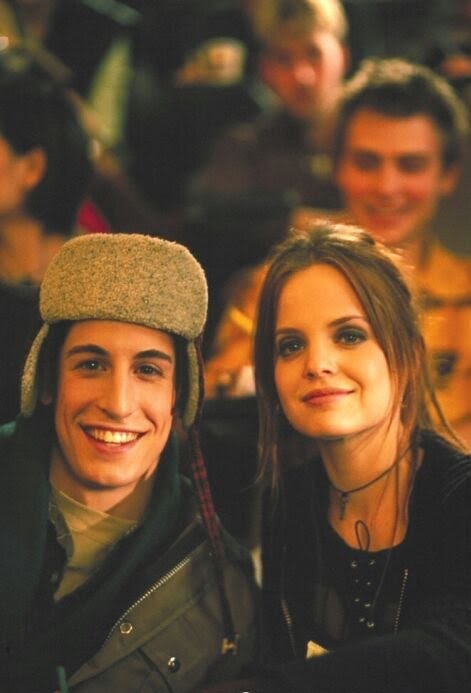
Amy Heckerling's 2000 romantic comedy, "Loser," came and went without making much of an impression.

But this shaggy little film is not without its fascination. Although no one would admit it at the time of its release, "Loser" is a rather transparent tracing-over of Billy Wiilder's "The Apartment." The similarities are striking and to writer-director Heckerling's credit, she pulls off the conceit in an amazingly clever way.

The skeletal plots are identical: Nerdy guy has a crush on a woman who likes him but who, in turn, has a crush on an authority figure who's taking advantage of her. In "The Apartment," these characters are played, respectively, by Jack Lemmon, Shirley MacLaine and Fred MacMurray.

In "Loser," their counterparts are Jason Biggs, Mena Suvari and Greg Kinnear. Wilder's film takes place within the confines of an insurance company; Heckerling's on a college campus.

Beyond its basic plotline, there are several scenes in "Loser" that echo Wilder's film:

(1) In "The Apartment," Shirley MacLaine stands up Jack Lemmon at a performance of "The Music Man." In "Loser," Jason Biggs is stood up by Suvari at a rock concert.

(2) In "The Apartment," a good doctor pumps a suicidal MacLaine's stomach and gives a warning to Lemmon, who pretends to be her boyfriend. In "Loser," a good doctor pumps a suicidal Suvari's stomach and gives a warning to Biggs who pretends to be Suvari's boyfriend.

(3) In "The Apartment," Lemmon's unsavory superiors party at his place and he has to clean up afterwards. In "Loser," Bigg's unsavory roommates party at his place and he has to clean up afterwards.

(4) In "The Apartment," MacLaine stays at Lemmon's place to recuperate and he offers to cook for her. In "Loser," Suvari stays at Biggs' place and he offers to cook for her.

(5) At the conclusion of "The Apartment," Fred MacMurray complains to MacLaine how Lemmon "threw that big, fat promotion in my face." At the conclusion of "Loser," Greg Kinnear complains how Biggs' threw a big "A grade" back in his face.

(6) Both films end with the heroine finally wising up and rushing back to the hero's apartment/animal hospital quarters for a happy ending.

At the time of the film's release, Heckerling, who happened to adapt Jane Austen's "Emma," with tremendous success, into 1995's "Clueless," was quoted as saying that the similarities were coincidental.

Perhaps.

And perhaps Wilder, who was still alive at the time, gave his blessing. After all, he was something of a mentor to Heckerling, having signed her application for membership in the Directors Guild of America.

Bottom line: There's absolutely nothing wrong with paying homage. It happens all the time in movies. Anyway, "Loser," whose title unfortunately proved to be prophetic at the box office, clearly deserves a second look - and perhaps in tandem with - back-to-back with - "The Apartment."

Tuesday, February 28, 2012

Mr. Dobbs Goes to Hollywood

Will wonders never cease? Lou Dobbs of the eponymous "Lou Dobbs Tonight" on the Fox Business Network, has made the startling discovery that two new family-friendly animations - Disney's "The Secret World of Arrietty" and Universal's "Dr. Seuss' The Lorax" - come with a liberal bias.

The wonder that fails to cease is not that Dobbs made this predictable and unoriginal observation, but that I agree with him. Yes, yes - both "Arrietty" and "Lorax" are wonderfully, gloriously left-leaning.

This isn't the first time this year that a radical-right crackpot has denounced Hollywood's menu for children. "The Muppets," "Cars 2" and "Happy Feet 2" were also "exposed" as some kind of plot.

But my immediate interest is the "Arrietty"/"Lorax" scandal because Dobbs not only dismisses both titles as “insidious nonsense from Hollywood” because of their rather transparent, often blunt political themes, but also claims that “Hollywood is once again trying to indoctrinate our children.”

"Indoctrinate"? The word I'd use is "enlighten."

"The Secret World of Arrietty," based on the beloved Mary Norton book, "The Borrowers," about tiny denizens who “borrow” their life essentials from humans, is not about "class envy and redistribution of wealth," as Dobbs puts it, but about having empathy for something foreign or different. Also, it's from Japan, not Hollywood. I guess that's worse.

"Dr. Seuss' Lorax"? Well, Dobbs says that this one is yet another example of "environmental radicalism" and, you know - pause - it is! But so what. The film, about a willfully clueless tree assassin, is also anti-corporate America and makes no effort whatsoever to hide this fact. I say huzzah.

Anyway, two points that I learned during my decades as a movie critic is that (1) everybody has an opinion about movies and (2) frankly, precious few of these people actually know what they are talking about.

I find them rather tiresome.

Earth to Mr. Dobbs: All movies have an agenda and/or some sort of political content. Your discovery is not exactly a revelation.

I wonder if you've paid heed to John Huston's 1982 screen adaptation of the musical "Annie" - based, of course, on "Little Orphan Annie" - and its none-too-vaguely anti-Capitalist undertones. Leapin' Lizards!

Sunday, February 26, 2012

outliers

How ironic that the GOP so intensely hates Hollywood.

I mean, the two entities are essentially the same.

True, the GOP may be conservative and Hollywood is largely liberal, but both are almost entirely driven by wealthy, aging white men who believe that money can buy anything - political elections or movie awards.

Both have been "corrupted by money," to quote "Curb Your Enthisiasm's" Gavin Polone in his astute "Oscar Farce" essay written for New York magazine (January 30). The whole process has become so cynical that the Oscarcast isn't even "kitschy fun" (Polone's words again) anymore.

Fact is, the show is now upstaged by the Red Carpet foolishness that precedes it. Don't get me started!

This handily explains why something as middle-brow as "The King's Speech" won over the bracing and exhilarating "The Social Network" last year - and why, in the throes of misguided love, the Academy members always fawn over the latest "It" person, predictably ignoring an industry vet who has paid his/her dues. Roberto Benigni, anyone?

Yeah, predictable is the word. Personally, I don't care who or what wins tonight. Except for George Clooney. If his inspiring, heartfelt, no-frills work in "The Descendants" is brushed aside for the novelty of the industry's latest "flash act" - Jean Dujardin, who will probably be part of this year's predictable "The Artist" sweep - well, I'll rest my case.

The current logic is that all those aging white men are smitten with "The Artist" because it's seen as a love letter to Hollywood. But the same argument could be made on behalf of the far superior "Hugo."

Full disclosure: I came to this piece with an attitude. I was already primed to pontificate after the performance of the year - Michael Fassbender's as a damaged sex addict in Steve McQueen's "Shame" - was (again, predictrably) neglected by the Academy's old white males.

But did I really expect a performance in an NC-17 film, regardless of how major it is, to receive the credit it deserves?

And then there's "Margaret"! Don't get me started!

Well, my planned rant, however, was upended by someone who got there first.

"I would have appreciated seeing Kenneth Lonergan's 'Margaret' get some respect," Sean Axmaker wrote in a terrific piece on Oscar Snubs for msn.com. "His beautifully messy and admirably unkempt script captures the messiness of human lives and unresolved emotions in the wake of 9/11, which looms in the background through lingering anxieties and anger. This year swings so far in the other direction of Big Films with Important Messages Hammered Home with Insistent Direction that the indie films that spurred the expansion were all but ignored. I suppose the art house take on a grindhouse story left 'Drive' in the dust and Fox effectively sabotaged grass-roots support for Lonergan's 'Margaret' by burying the film after a nominal release, but if the Academy really wants audience-friendly films, you can't do better than 'Rise of the Planet of the Apes,' Rupert Wyatt's reboot of the kitchy science fiction franchise as a gripping prison break thriller with a wicked high-concept twist." Well put.

That said, given that this site is devoted to the neglected, here's a nod to this year's Oscar outsiders (losers, I suppose, in Hollywood's eye):

Michael Fassbinder & Carey Mulligan ("Shame")

Leonardo DiCaprio, Armie Hammer & Clint Eastwood ("J. Edgar")

Charlize Theron ("Young Adult")

Albert Brooks ("Drive")

Ryan Gosling ("Drive," "The Ides of March" & "Crazy, Stupid, Love" - take your pick)

Michael Shannon ("Take Shelter")

Brendan Gleeson ("The Guard")

Anna Paquin & Jeannie Berlin ("Margaret")

Andy Serkis ("Rise of the Planet of the Apes")

Christoph Waltz ("Carnage")

David Fincher ("The Girl with the Dragon Tattoo")

And "the kids"...

Asa Butterfield & Chloƫ Grace Moretz ("Hugo")

Shailene Woodley ("The Descendants")

Elle Fanning ("Super 8")

They didn't stand a chance in a solipsistic, middle-brow organization ingrained with ageism. Don't get me started!