Showing posts sorted by relevance for query indelible moment:. Sort by date Show all posts

Wednesday, August 04, 2010

indelible moment: "Marley & Me" (2008)

Because of the logistics of modern film criticism - the relentless assembly-line of releases, the deadening deadlines, impossible editors, frustrating compromises, ad infinitum - reviewers don't have the luxury of kicking back and savoring the small details. Often, they miss them.

One of the most powerful moments in recent films comes towards the end of "Marley & Me," David Frankel's 2008 adaptation of the John Grogan book which essentially follows the life of a dog, a rascally yellow labrador retriever, from puppyhood to death. The well-honed screenplay was written by ace scenarist Scott Frank ("Get Shorty," "Minority Report" and "Out of Sight") and indie filmmaker Don Roos ("The Opposite of Sex"), but the scene in question is a brief, conspicuously wordless one.


In it, Ann Dowd, playing the family veterinarian, excuses herself so Owen Wilson can say goodbye to a seriously ill Marley, who is about to be put down. Florian Ballhaus's camera slowly follows Wilson's hand, in close-up, as he strokes Marley's coat for the last time. Frankel ("The Devil Wears Prada") worked to keep the moment short, silent, incredibly sensual, achingly sad and wholly memorable. Yes, indelible.

In his "Screen World" assessment of the movie year 2008, author Barry Monush honored Frankel's film "for being something more than just the obvious doggie flick that it looked like on the surface." This lovely sequence quietly advances that observation of "Marley and Me."

indelible moment will be a recurring feature on The Passionate Moviegoer, honoring those small, gem-like moments in movies that have the power to haunt one's memories and dreams. Recommendations?

Friday, February 21, 2014

indelible moment: Ross's "Goodbye, Mr. Chips"

Perhaps I'm a cynic but only a precious few sad films manipulate me. I'm too aware of the mechanations to be reduced to tears. But Herbert Ross's 1969 musical remake of James Hilton's "Goodbye, Mr. Chips" never fails to tear me up. Perhaps I relate to the delicate acting duet shared by Peter O'Toole and Petula Clark, respectively introverted and extroverted here.

Hilton's 1934 novel (also the source of the 1939 Sam Wood film with Robert Donat and Greer Garson) is an incredibly sad tale of a man (O'Toole), a reserved teacher at a British boys' boarding school, who is fated to be alone. For one brief moment, a woman (Clark), a music-hall entertainer, comes into his life, igniting it, but her presence proves to be wrenchingly brief. Mr. Chips' life ends the way it began - in solitude.

Hilton aptly described his tale as "a long short story."

The shot of Mrs. Chips speeding off in a jeep to participate in the war effort as entertainer to the troops, waving a seeming temporary farewell to her husband is fleeting. It will be Chips' last image of his beloved wife. She will never return. It is a genuinely sad, truly indelible moment.

O'Toole brings immense dignity and feeling to his reading of Terence Rattigan's dialogue and Leslie Bricusse's lyrics. Clark, meanwhile, demonstrates that she was made to be a leading screen soubrette. Alas, that never happened. Much like her character in the film, this is one of the last times we would see Petula Clark. At least, on screen.

Tuesday, August 08, 2017

indelible moment: DaCosta's "Auntie Mame"

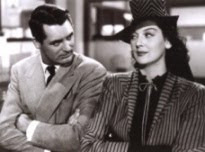
That incorrigible Liberal, Mame Dennis, trapped by arch Conservatives (and close talkers) Doris and Claude Upson who threaten to turn her beloved nephew Patrick into "an Aryan from Darien"

For my money, there are any number of memorable moments in Morton DaCosta's hugely entertaining film of his Broadway hit, "Auntie Mame."

Armed with a terrific script by Betty Comdon and Adolph Green (working from the stage original by Jerome Lawrence and Robert E. Lee) and abetted by his Broadway star, Rosalind Russell (plus the divine Coral Browne), DaCosta breezily swept his audience from one richly comic scene to another. There are umpteen of them in "Auntie Mame" and singling out one is near-impossible, but my hands-down favorite arrives late in the film when Russell's Mame Dennis pays a visit to her nephew Patrick's future in-laws, Claude and Doris Upson, at their Colonial-style manse in Mountebank (their signpost reads "Upson Downs"), described as being "right above Darien and completely exclusive and restricted."

"Exclusive to what and restricted to whom?," asks an annoyed, impatient Mame. Mame Dennis, you see, has zero tolerance of intolerance.

Claude and Doris, played to the hilt by Willard Waterman and Lee Patrick, are Conservative to the max, terribly unctuous and given to talking up close. Mame, on the other hand, is a Liberal and decidedly a provocateur.

The Upsons' flagstone patio is decorated to reflect "authentic Colonial Americana" (Doris' words), replete with assorted chachkes and a spinning wheel. (Robert Hanley and George James Hopkins collaborated on the witty set decorations for the film.) While plying Mame with "daiquiris made with honey" and canapes made of "strained tuna fish, clam juice and peanut butter" (a recipe from the Ladies Home Journal), the Upsons announce that they plan for Mame to go in with them and buy the adjoining property as a wedding gift for Patrick and their daughter, Gloria.

The phonograph in the background is playing "Tiptoe Through the Tulips," as Claude shakes his daiquiri mixture in time to the rhythm.

"But we have to move fast," Claude intones. "Some people are bidding on that property. The wrong kind. Fella named Epstein. A-bra-ham Epstein."

"This section is restricted only to our property line," Doris adds. "So we feel we have an obligation to make sure that - well - you know."

Exactly how Mame upends the Upsons' plans provides the film with the perfect punchline/comeuppance - and me with an indelible moment.

Made more than five decades ago, DaCosta's "Auntie Mame" remains a bracing, ever-modern cheer for the left that the right can
enjoy. 

~image~

~Lee Patrick, Rosalind Russell and Willard Waterman in a scene from "Auntie Mame"
~Warner Bros. 1958 © 

Tuesday, June 05, 2018

indelible moment: "Bang the Drum Slowly"

Sports-oriented male soap operas aren't my bag. I mean, I can take or leave "Brian's Song." But there's something about Robert DeNiro's vulnerable performance in John Hancock's "Bang the Drum Slowly" (1973) - as Bruce Pearson, a rather slow-witted catcher from Georgia who comes down with a terminal illness - that brings a lump to my throat. Mostly because DeNiro, out of character, admirably underplays the role.

The film's indelible moment comes early on when Bruce, preparing for death, has gathered together all his baseball mementos, awards and clippings and quietly slips out one night and burns them in a farewell bonfire. The sequence lasts a few seconds but you can smell the smoke.

It stays with you forever.


Regarding Comments: All comments are enthusiastically appreciated but are moderated before publication. Replies signed "unknown" or "anonymous" are not encouraged. Please sign any response with a name (real or fabricated) or initials.  Be advised that a "name" will be assigned to any accepted post signed "unknown" or "anonymous." Thank you.

~images~
(from top) 

~A burning newspaper page in "Bang the Drum Slowly"
~Robert DeNiro burning his memorabilia in a scene from the film 
~photography: Paramount Pictures 1973©

Monday, March 14, 2016

indelible moment: Levine's "The Night Before"

© Sarah Shatz/Columbis Pictures
 Gordon-Levitt and Cyrus, crooning

There are certain comedy genres that are irresistible, one of which is the "night on the town" comedy as exemplified by everything from Martin Scorsese's "After Hours" (1985) to Chris Columbus' "Adventures in Babysitting" (1987) - movies in which a night goes on seemingly forever.

One of the best (and an all-around terrific comedy in general) is Jonathan Levine's "The Night Before" (2015), about three guys - played by Joseph Gordon-Levitt, Seth Rogan and Anthony Mackie - who traditionally stretch every Christmas Eve into a night-long tradition of brief encounters and non-stop fun, again another blissful night that goes on seemingly forever.

Jonathan Levine is a name that is new to me and, despite his youth, he brings a certain sophistication and gracefulness to the on-going carousing in his film, helped in no small measure by Brando Trost's shimmering cinematography.  This hip movie looks like the fabulous party that it is.

The film's penultimate moment comes in a club where just about the film's entire cast congregates - Gordon-Levitt, Rogan, Mackie, Mindy Kaling, James Franco, Lizzy Caplan and the singular Miley Cyrus, who is performing at the club.  When Gordon-Levitt jumps on stage to join Miley in a duet of "Wrecking Ball," his way of proposing to Caplan, the moment becomes magical.  Although they're not in this sequence, one can feel the presence of co-stars Michael Shannon, Jillian Bell, Lorraine Toussaint and the incorrigible Ilana Glazer ("Broad City"!), who plays a Christmas-hating street-prowler named ... Rebecca Grinch. A companionable bunch all.

Levine also has a shrewd eye for casting.  This is a hip, terrific ensemble here. Companionable indeed.

Friday, November 04, 2016

indelible moment: Donen's "The Little Prince"

In the mid-1970s, Stanley Donen teamed up with Alan Jay Lerner and Frederick Loewe - you know, the guys who did "My Fair Lady" - for a musical film based on Antoine de Saint-Exupéry beloved gem, "The Little Prince"/"Le Petit Prince." The film was troubled given that the casting of The Pilot - Frank Sinatra, Gene Hackman, Jean-Louis Trintignant and Richard Burton were all suggested - proved gnawingly elusive.

Reliable Richard Kiley would play the role.

The resulting film ran a trim 88 minutes which was considered perfect in some quarters and suspect in others. Studio intervention? Hmmm. Donna McKechnie's role as The Rose seemed particularly truncated. But, overall, the movie is a tiny gem. Donen got it right, particularly in his casting of Bob Fosse as The Snake and, truly inspired, Gene Wilder as The Fox.

The film's stand-out moment is also the book's: It comes when Wilder, with his champagne-colored, fluffy hair and dressed in a handsome auburn suit, scurries about and stops in a field of wheat to intone:


                "It's only with the heart that one can see clearly.
                     What's essential, is invisible to the eye."

Lovely. And, yes, indelible.

Saturday, September 25, 2010

indelible moment: "Bell, Book and Candle"

Richard Quine's "Bell, Book and Candle" (1958) is one of those rare films that not only seems to improve with age but also strikes me as ageless. It's timelessly contemporary, whether you saw it in '58, '88 or '08.

In that sense, it's magical, a quality that drives its most enchanting sequence - when Kim Novak and her cat Pyewacket bewitch Jimmy Stewart, complemented by George Duning's lilting theme, hummed by Novak, and James Wong Howe's shimmering cinematography. (Duning, by the way, came to call his title track for the film ... "Kim's theme.")

The moment is creamy, dreamy and, well, indelible.

Saturday, November 02, 2013

indelible moment: "Picnic" (1955)

Ah, the days when filmmakers had to be creative.

I'm not talking about cinematics but content. However, in this case, cinematics and content are irrevocably intertwined. In bringing William Inge's seminal play of longing to the screen (by way of Daniel Taradash's fine screenplay), director Joshua Logan faced the challenge of having the piece's star-crossed lovers - stumble-bum Hal and small-town queen Madge - be intimate with actually showing them engaging in sex.

He shrewdly solved the problem with a dance that has become an iconic screen moment, even though is lasts only a minute or so. Swooning and gyrating to "Moonglow" and "The Theme from 'Picnic,'" expertly intertwined by composer George Duning, stars William Holden and Kim Novak seem to be improvising their choreographed sex act.

But, in actuality, the dance was overseen by choreographer Miriam Nelson who, for some bizarre reason, was never credited.

Nevertheless, what she created in ... indelible.

Note in Passing: Turner Classic Movies will screen "Picnic" at 8 p.m. (est) on Wednesday, 1 September - in anticipation of Labor Day, aptly enough the backdrop of the film.

Friday, May 19, 2017

indelible moment: "North by Northwest"

Hitchcock's compulsively watchable masterpiece, "North by Northwest" (1959), contains any number of memorable moments.  Hell, the entire film is a memorable moment. But one scene, in particular, stands out for me.

It occurs rather early in the film when Cary Grant returns to the Plaza Hotel - accompanied by the fabulous Jessie Royce Landis, playing his glib, eye-rolling mother - to search the room of one George Kaplan, for whom Cary's Roger O. Thornhill, an advertising executive, has been mistaken.

Snooping around in the suite's bathroom, Cary examins a hairbrush.

Walking back into the bedroom, he announces to mother (in a deadpan manner patented by Grant), "Bulletin! George Kaplan has dandruff."

Grant's body language, telegraphing disgust with the idea of dandruff, perfectly complements his line reading.  He hunches his shoulders and slightly flails his arms, making spindly movements with his fingers:

"Bulletin! George Kaplan has dandruff."

Brilliant, just brilliant.

* * * * *
~image: still shot of Cary Grant and Jessie Royce Landis in "North by Northwest" / MGM 1959 ©

Wednesday, August 01, 2018

indelible moment: DaCosta's "The Music Man"

Not Surprisingly, Morton DaCosta has never been appreciated among rigid cinéphiles. He directed only three films, two of which were based on stage plays that he helmed - and rather triumphantly - on Broadway.

They would be "Auntie Mame" and "The Music Man."

I suppose that his status as a stage director made him a questionable filmmaker in the minds of those who self-identify as cinematic purists.

But the two DaCosta films based on his stage successes are anything but lacking. Far from it. "Auntie Mame" (1958) and "The Music Man" (1962), both Warner Bros. titles, are films that have a fierce fidelity to their respective source material but are also uncannily - creatively - cinematic.

He shrewdly honored the works' stage backgrounds by employing a curious blackout device to end certain sequences in both films. The lighting grows dim in certain scenes until the characters on screen are surrounded in blackness - very much a stage-bound device but one that works.

DaCosta's eye for the film medium, meanwhile - which crops up when one least expects it - is especially evident in his witty staging of the piano lesson near the beginning of "The Music Man," set during the clever Meredith Willson musical number, "If You Don't Mind My Saying So."

Shirley Jones is the piano teacher to Monique Vermont's student and, for the occasion of the lesson, DaCosta and cinematographer Robert Burks playfully filled the expansive Technirama screen with the piano's entire keyboard. It's a visually eccentric moment and it jumps out at me - like a pop-out book - every time I watch this wonderful musical (which is often).
Note in Passing: DaCosta's third film, also for Warner Bros., was 1963's "Island of Love," starring his "Music Man" lead Robert Preston, Tony Randall, Walter Matthau and Betty Bruce. It was decidedly not based on a stage play. Turner Classic Movies will screen it 6 a.m. (est) on August 9th.

Regarding Comments: All comments are enthusiastically appreciated but are moderated before publication. Replies signed "unknown" or "anonymous" are not encouraged. Please sign any response with a name (real or fabricated) or initials.  Be advised that a "name" will be assigned to any accepted post signed "unknown" or "anonymous." Thank you.

~images~

~Shirley Jones and Monique Vermont in the "If You Don't Mind My Saying So number from ""The Music Man"
~photography: Warner Bros. 1962©

Monday, April 14, 2014

indelible moment: "Mean Girls" (2004)


Gretchen Weiners: "That is so fetch!"

Regina George: "Gretchen, stop trying to make 'fetch' happen! It's so not going to happen!"

Rachel McAdams as the alpha mean girl of The Plastics setting Lacey Chabert straight on her phraseology in Mark Waters' delightful teen comedy.

Saturday, November 01, 2014

indelible moment: "The Graduate" (1967)

It's 1967. The movie is Mike Nichols' "The Graduate," adapted by Buck Henry and Calder Willingham from Charles Webb's novel.

Dustin Hoffman, as recent graduate Benjamin Braddock, is talking with Elisabeth Frazer, as Joanne, a friend of his parents, when they are interrupted by Mr. McQuire, played by Walter Brooke.

Mr. McQuire's one-word recommendation to Benjamin brought gales of laughter in theaters - and still does, even though that word has proven to be eerily prophetic.

Joanne: "What are you going to do now?"
Ben: "I was going to go upstairs for a minute."
Joanne: "I mean with your future - your life."
Ben: "That's a little bit hard to say."
Mr. McGuire: (interrupting them) "Ben."
Benjamin: (to Joanne) "Excuse me."
Benjamin: (turning away from Joanne) "Mr. McGuire!"
Mr. McGuire: "Ben."
Benjamin: (voice trailing off) "Mr. McGuire."
Mr.McGuire: "Come with me for a minute. I want to talk to you. Excuse us, Joanne?"
Joanne: "Of course."

(pause)

Mr. McGuire: "I just want to say one word to you. Just one word."
Benjamin: "Yes, sir."
Mr. McGuire: "Are you listening?"
Benjamin: "Yes, I am."
Mr. McGuire: "Plastics."
Benjamin: "Exactly how do you mean?"
Mr.McGuire: "There's a great future in plastics. Think about it. Will you think about it?"
Ben: "Yes, I will."
Mr. McGuire: "Enough said. That's a deal."

Tuesday, October 04, 2016

indelible moment: "Sometimes a Great Notion"


Richard Jaekel's heartbreaking drowning/death in the 1972 film directed by and co-starring Paul Newman. Utterly unforgettable.

Monday, January 13, 2014

indelible moment: John Huston's "The Misfits"


"Horse killers! Killers! Murderers!

"You're liars! All of you, liars!

"You're only happy when you can see something die!

"Why don't you kill yourselves and be happy?!

"You and your God's country! Freedom! I pity you! You're three dear, sweet, dead men!

"Butchers! Murderers!

"I pity you! You're three dead men!"


-Marilyn Monroe as Roslyn, a lonely, stricken divorcée begging three modern cowboys - played by Clark Gable, Montgomery Clift and Eli Wallach - not to trap wild horses for dog food  

Sunday, August 02, 2015

indelible moment: "Strangers on a Train"


Hitchcock, working without the benefit of CGI

Sunday, August 05, 2012

indelible moment: Wilder's "Some Like It Hot"

Jerry (to himself): "I'm a girl. I'm a girl. I'm a girl."

His eyes stray down the aisle. In Upper 2, Sugar is getting ready for bed. All Jerry can see is her legs dangling out of the berth as she removes her stockings. But that's all the indenitification Jerry needs.

Jerry (calling down the aisle): "Good night, Sugar!"

Sugar (sticking her head out): "Good night, honey."

Note in Passing: "Good night, honey," indeed. Today marks the 50th anniversary of Marilyn's passing. As columnist Dorothy Kilgallen wrote at the time of MM's death, "Sleep well, sweet girl. You have left more of a legacy than most, if all you ever left was a handful of photographs of one of the loveliest women who ever walked the earth."

Good night, Sugar!

Tuesday, October 01, 2013

indelible moment: Wilder's "The Apartment"

 "I don't want people to think I'm an entertainer..."

From under the desk, C.C.("Bud") Baxter (Jack Lemmon) has produced a hatbox, and out of the hatbox a black bowler, which he now puts on his head.

Bud: It's what they call the junior executive model. What do you think?

Fran (Shirley MacLaine), the elevator operator on whom Bud has a crush, looks at him blankly, absorbed in her own thoughts. 

Bud (continuing): Guess I made a boo-boo, huh?

Fran (paying attention again): No - I like it.

Bud: Really? You mean you wouldn't be ashamed to be seen with somebody in a hat like this?

Fran: Of course not.

Bud: Maybe if I wore it a little more to the side - (adjusting the hat) is that better?

Fran: Much better.

Bud:  You don't think it's tilted a little too much.

Fran takes her compact out of her uniform pocket, opens it, hands it to Bud.

Fran: Here.

Bud (examining himself in the mirror): After all, this is a conservative firm - I don't want people to think I'm an entertainer...

His voice trails off. There is something familiar about the cracked mirror of the compact -- and the fleur-de-lis pattern on the case confirms his suspicion. Fran notices the peculiar expression on his face.

Fran: What is it?

Bud (with difficulty): The mirror - it's ... broken.

Fran: I know. I like it this way - makes me look the way I feel.
"(it) makes me look the way I feel"

Saturday, August 26, 2017

indelible moment: "The Notorious Landlady"

"Some Like It Hot" (1959) is probably the one comedy classic for which Jack Lemmon is best remembered. It was directed by one of his mentors, Billy Wilder, and it predictably tops every Best Comedies film list.

But Jack had another collaborator for whom he starred in comedies that were equally great (and undeservedly neglected) - Richard Quine.

Together, at their home base at Columbia, they made the superior musical "My Sister Eileen" (1955), the scrappy service farce "Operation Mad Ball" (1957), the bewitching "Bell, Book and Candle" (1958), the it-gets-better-with-age "It Happened to Jane" (1959) and especially the sophisticated "The Notorious Landlady" (1962), a playful, clever take on Hitchcock.

"The Notorious Landlady" is my preferred Lemmon movie (hands-down) and one of my favorite films in general. Its titanic supporting structure is, of course, its sceenplay - an incredibly literate affair penned by no less than Blake Edwards and Larry Gelbart, by way of British nutneggy Margery Sharp, who wrote the short story (originally published in the Saturday Even Post as "The Notorious Tenant") on which the script is based.

Quine's direction here is his most assured as he blends subtle comedy, snappy repartee and Hitchcock quotes with incredible, impressive ease.

One memorable scene follows another, the highlight of which is a comic chase staged at Penzance, the location of an elderly residence whose tenants are enjoying an open-air concert atop the forbidding cliffs.

Here is Jack in a selection of shots bounding through the air in the film's climatic and wonderful chase sequence, which Quine and composer George Duning set to selections from - what else? -  "The Pirates of Penzance" and other Gilbert and Sullivan goodies. "Take me back before I miss "The Mikado!," the wheelchair-bound Estelle Winwood snaps at her nefarious caregiver, Phileppa Bevans, before Winwood is pushed down a rocky hill.  The scene makes me want to jump, tumble and fly, too. Enjoy!


Note in Passing: Richard Quine directed Jack Lemmon's screen test when Jack was hired by Columbia and put under contract by Harry Cohn and, along with Wilder, Quine was a Best Man at Jack's wedding to Felicia Farr in Paris in 1962, the year "The Notorious Landlady" was released. Kim Novak, Jack's co-star in "The Notorious Landlady" and Quine's muse, also attended the wedding. Wilder and Lemmon were in Paris at the time, with Shirley MacLaine, filming exteriors for "Irma La Douce" (1963).

~images~
~Jack Be Nimble - Lemmon doing his own stunt work in "The Notorious Landlady"
~photography: Columbia Pictures, 1962©

Tuesday, December 20, 2016

indelible moment: "Scrooge" (1970)

One of the most delightfully perverse moments in movie-musical history is performed early on in "Scrooge," Ronald Neame's 1970 adaptation of Charles Dickens' "A Christmas Carol," with songs by Leslie Bricusse.

In it, Albert Finney, so obviously relishing the role of Ebenezer, lurches through the streets of London, scowling at passersby and declaring in rhyme (courtesy of Bricusse's intricate, socially incorrect wordplay): 

"Scavengers and sycophants and flatterers and fools
Pharisees and parasites and hypocrites and ghouls
Calculating swindlers, prevaricating frauds
Perpetrating evil as they roam the earth in hordes
Feeding on their fellow men
Reaping rich rewards
Contaminating everything they see
Corrupting honest men like me!"

"Humbug! Poppycock! Balderdash! Bah!," Finney/Scrooge declares before breaking into Bricusse's marvelously demented song, "I Hate People," whose lyric sounds even more deranged when seen on paper. Or in this case, on computer screen.  Happy Holidays?  Indeed. Here goes...

"I hate people!
I hate people!
People are despicable creatures
Loathesome, inexplicable creatures
Good-for-nothing, kickable creatures
I hate people!
I abhor them!
When I see the indolent classes
Sitting on their indolent asses
Gulping ale from indolent glasses
I hate people!
I detest them!
I deplore them!
Fools who have no money but spend it
Get in debt, then try to end it
Beg me on their knees to befriend them
Knowing I have cash to lend them
Soft-hearted me! Hard-working me!
Clean-living, thrifty and kind as can be!
Situations like this are of no interest to me
I hate people!
I loathe people!
I despise and abominate people!
Life is full of cretinous wretches
Earning what their sweatiness fetches
Empty minds whose pettiness stretches
Further than I can see
Little wonder I hate people
And I don't care if they hate ... me!"

Sunday, February 01, 2015

indelible moment: Aldrich's "What Ever Happened to Baby Jane?"


"You mean, all this time we coulda been ... friends?"
-Baby Jane Hudson to her sister Blanche, dying on a Santa Monica beach.