In fact, the film's working title was "Old 97 Goes to Market," a play on two Capra vehicles - "Mr. Deeds Goes to Town" (1936) and "Mr. Smith Goes to Washington" (1939), movies of staunch Americana that "Jane" successfully emulates. While Capra was restricted largely to backlot filmmaking, Quine brought his story of a small-town lobster farmer and her first selectman-boyfriend into the open air of New England (Chester, Connecticut standing in for the fictional Cape Ann, Maine) and with a few vivid vérité touches.
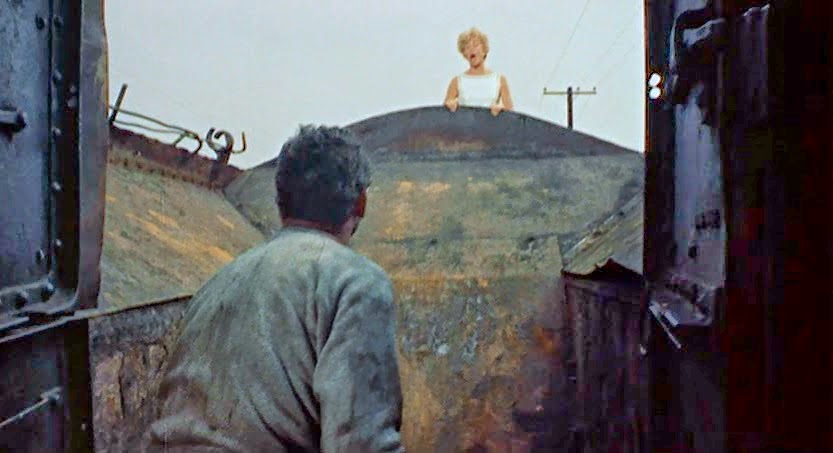
Among the indelible moments in this charming film are an exhilarating town meeting (with all the extras played by Chester residents); the final sequence which includes a performance by the Chester Fife and Drum Corps (which was was formed in 1868 and is still going strong), and a wildly inventive sequence in which Jane Osgood (Doris Day), feeling she needs an answer right now, climbs on the back of the engine of the locomotive Old 97 to coerce her lifelong boyfriend George Denham (Jack Lemmon) into proposing while he is hectically trying to shovel enough coal into Old 97's furnace to keep it moving. As his Uncle Otis (Russ Brown) testily demands "More steam!," George struggles to divide his attention between the needs of both the speeding train and the impatient Jane.
Because of the din of the rushing, rumbling train, all of the dialogue is
shouted and emphatic and George can't quite make out what Jane is trying to say to him. This is vérité at its most vigorous and exhilarating:
Jane: “George! George!”
George: “What?!”
Jane: “I think I’m getting married today!”
George: “What?!”
Jane: “I said I’m getting
married today!”


Jane: “I am not being silly!”
George: “What are you
talking about?!”
Uncle Otis (to George): “More steam!”


George (trying to listen to both Uncle Otis and Jane): “What?!
What?!!”
Jane: "Lawrence Clayborn Hall is waiting for me in Marshalltown and I am going to marry him!"
George: “Just like that?!”
Jane: “No, not just like that, George . He asked me!”
Uncle Otis (to George):
“George, More steam! Steam!”

George: “After knowing you for four days, he asked you to
marry him? I think he’s probably asked
every girl he ever knew to marry him! He’s
neurotic or something. If you remember correctly,
I asked you to marry me 21 years ago!”
Jane: “Yes, and you
haven’t asked me since!”
George: “What?!”
Jane: “I’m a woman and I’m supposed to be married! I’m a mother and I need a man to take care of
me and my children!”
George: “You don’t have to go to Marshalltown to find one!”

Jane: “Don’t I, George?”
George: “No!”
Jane: “Where can I find one?”
George: “You don’t have to go anywhere! You can stay right in Cape Ann!”
Jane: “Can I, George?”
George: “You know you can!”
Jane: “Do I?” (a pause)
“Well, say it! Can’t you just say it?”
George: “Say what?!”
Jane: “Say anything!
Why can’t you be neurotic like Larry and say you’ll marry me?!”
George: “Well, you know I will!”
Jane: “Oh, George! You proposed!”


Uncle Otis (to George): “More steam!”
George (murmurs to Uncle Otis): “Yeah, wait.”
Jane: “George!
George! You did! You proposed!
George!”
George stops to climb up to where Jane is to kiss her.
Uncle Otis (to George):
“We need more coal!”
Jane (giddy with delight): “George, I love you!”
George climbs back down.
George (to Jane): “I love you!”
George (to Uncle Otis): “What coal?”
Jane (again, giddy with delight): “George, I love you!”
George (to Jane): “I Love you!”
George (to Uncle Otis): “No coal!”
Uncle Otis (quoting Teddy Roosevelt): “Bully!”
 It's
been rumored, falsely, that Harry Foster Malone, the monied villain
played by Ernie Kovacs in “It Happened to Jane,," was modeled after
Charles Foster Kane in Orson Welles' "Citizen Kane" (1941).
It's
been rumored, falsely, that Harry Foster Malone, the monied villain
played by Ernie Kovacs in “It Happened to Jane,," was modeled after
Charles Foster Kane in Orson Welles' "Citizen Kane" (1941).
It's an easy assumption to make. While the character's middle name, Foster, was probably borrowed from Welles, the name Harry itself actually comes from ... Harry Cohn, the legendary head of Columbia Pictures, which produced and released "It Happened to Jane."
True, the name Foster seems to be a dead giveaway but it's also a distraction. While we were working on a book together, Jack Lemmon told me that Kovacs' Harry Foster Malone was based directly on Cohn, who died while Lemmon, Kovacs and Quine were making "Bell, Book and Candle" the year before. Kovacs affected Cohn's look for his wicked impersonation by donning a bald plate for the film and gaining 40 pounds.
He also appropriated Cohn's infamously foul-tempered, autocractic and abrasive personality for the role. There's really nothing of Charles Foster Kane in Kovacs' movie-stealing performance.
* * *
A few notes on "It Happened to Jane"... It's
been rumored, falsely, that Harry Foster Malone, the monied villain
played by Ernie Kovacs in “It Happened to Jane,," was modeled after
Charles Foster Kane in Orson Welles' "Citizen Kane" (1941).
It's
been rumored, falsely, that Harry Foster Malone, the monied villain
played by Ernie Kovacs in “It Happened to Jane,," was modeled after
Charles Foster Kane in Orson Welles' "Citizen Kane" (1941).It's an easy assumption to make. While the character's middle name, Foster, was probably borrowed from Welles, the name Harry itself actually comes from ... Harry Cohn, the legendary head of Columbia Pictures, which produced and released "It Happened to Jane."
True, the name Foster seems to be a dead giveaway but it's also a distraction. While we were working on a book together, Jack Lemmon told me that Kovacs' Harry Foster Malone was based directly on Cohn, who died while Lemmon, Kovacs and Quine were making "Bell, Book and Candle" the year before. Kovacs affected Cohn's look for his wicked impersonation by donning a bald plate for the film and gaining 40 pounds.
He also appropriated Cohn's infamously foul-tempered, autocractic and abrasive personality for the role. There's really nothing of Charles Foster Kane in Kovacs' movie-stealing performance.
Did he get the joke? No problem. Cohn, as noted, died on February 27, 1958, during the filming of "Bell, Book and Candle"; "It Happened to Jane" went into production June 2, 1958 and ended shooting July 31 of that year.
Nevertheless, the Kovacs-Welles rumor has persisted, supported surprisingly by Turner Movie Classics which is usually never less than fastidious in its research. I watch "Jane" whenever Turner airs it - I love the film - and in the introductions to the movie by Ben Mankiewicz, the source of Kovacs' performance is invariably misidentified.
I've no idea when it morphed into a Doris Day vehicle but both Quine and Lemmon were eager to work with her.
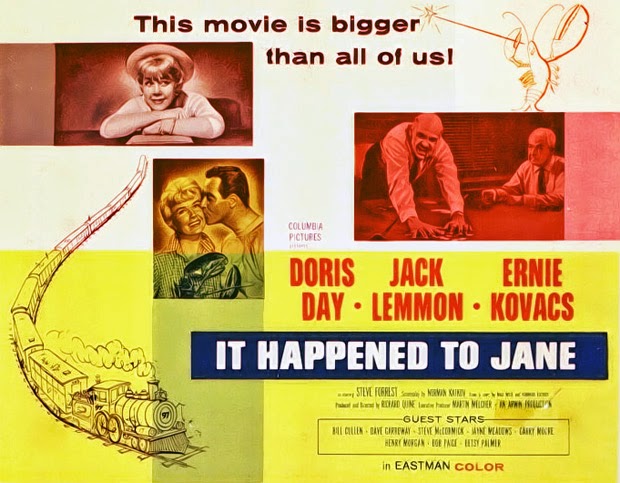
The film would go through more title changes - "Miss Casey Adams" and "As Jane Goes (As Maine Goes)"- before the studio settled on "It Happened to Jane." No one involved in the film particularly liked that moniker but it lent itself to a terrific, catchy title song by Joe Lubin (who worked often with Doris Day) and Irvin J. Roth (aka, Adam Ross), sung by Day over the main credits.

The movie was in post-production when the studio came up with yet another title, "That Jane from Maine," and had the composers rewrite "It Happened to Jane," changing the lyric but retaining the music. (That version of the song remained unreleased until it popped up on a Day album and subsequent CD; it can currently be heard on the CD, "Golden Girl.") But there was a problem: While "That Jane from Maine" was a better title, "It Happened to Jane" was the better song. So back to the original.
At least,I think that's the song/title chronology. It's madding.
In the meantime, Columbia had commissioned Marvin H. Albert to write a novelization of Norman Katkov and Max Wilk's script. The book was printed and ready to go under the title "That Jane from Maine" - it was too late to change - while the film went into theaters as "It Happened to Jane."
There were some theaters which sold copies of the softback novelization at their concession stands, certainly confusing their patrons.
"It Happened to Jane" was a good film that came at the wrong time for everyone concerned - its two stars, the public and the critics, who hastily dismissed it. Both Lemmon and Day were at the crossroads in their respective careers and "Jane," released in June of 1959, just didn't seem to fit in. Lemmon had a personal triumph three months earlier in March in Billy Wilder's "Some Like It Hot" (which was actually shot after "Jane") and Day was poised to reveal a major makeover with the October release of Michael Gordon's "Pillow Talk." Both were frank, sexed-up films.
By comparison, "It Happened to Jane" seemed a tad old-fashioned.
And a little square.

It would take"It Happened to Jane" several decades before it was recognized as the smart, alert farce that it is or before its undervalued maker, Richard Quine, would be appreciated as an auteur.

I may be a majority of one but it's my opinion that the train sequence showcased at the start of this essay is as good as anything that Billy Wilder gave Lemmon to do in "Some Like It Hot" or "The Apartment," or that Day got to do in "Pillow Talk" and her subsequent modern comedies.
Note in Passing: The location shooting of "It Happened to Jane in Chester was so pleasant and memorable that co-star Casey Adams (aka, Max Showalter), 1917-2000, purchased an 18th-century farmhouse and settled there, becoming involved in the local theater in his later years.

Regarding Comments:
All comments are enthusiastically appreciated but are moderated before
publication. Replies signed "unknown" or "anonymous" are not encouraged.
Please sign any response with a name (real or fabricated) or initials.
Be advised that a "name" will be assigned to any accepted post signed
"unknown" or "anonymous." Thank you.
* * * * *
~images~
(from top)
~Title credit for "It Happened to Jane"
~Assorted still shots from the film's train sequence
~Publicity shot of Ernie Kovacs as Harry Foster Malone
~Publicity shot of Ernie Kovacs as Harry Foster Malone
~14x22 window card for "It Happened to Jane"
~Cover for Marvin H. Albert novelization of the film's screenplay, then titled "That Jane from Maine"
~14x22 window card for the film's re-release under the title "Twinkle and Shine"
~Publicity shot of Casey Adams (aka Max Showalter)
~End credit for "It Happened to Jane"
~photography: Columbia 1959©
~Cover for Marvin H. Albert novelization of the film's screenplay, then titled "That Jane from Maine"
~14x22 window card for the film's re-release under the title "Twinkle and Shine"
~Publicity shot of Casey Adams (aka Max Showalter)
~End credit for "It Happened to Jane"
~photography: Columbia 1959©