Friday, January 20, 2012

cinema obscura: James Frawley's "The Christian Licorice Store" (1971)


Beau Bridges, one of my favorite actors, mades waves as a would-be hippie in his breakthrough film, the otherwise awful "For the Love Of Ivy" (1968).

Hollywood noticed - well, at least Norman Jewison did - and responded with two lead roles in a couple of promising titles, Jewison's "Gaily, Gaily" (1969) and Hal Ashby's "The Landlord" (1970), produced by Jewison. Both are really fine, dissimilar films, but in their day, each came and went, without making much impact.

Then something happened that can be described as only bad karma. Bridges made two films that virtually no one saw - Philip Leacock's Austalian-made "Adam's Woman," a 1970 film which Warners never bothered to release, and James Frawley's ultra-trendy "The Christian Licorice Store," which played only in Boston in 1971 and then was promptly shelved by the now-defunct Cinema Center Films.

"The Christian Licorice Store," the more intriguing of the two, opened November 24th, 1971 at Boston's Paris Cinema, and the Boston Globe dismissed it as "flat."

I caught up with it in New York in 1977 when exhibitor extraordinaire, the late Ralph Donnelly, opened it for a week at his First Avenue Screening Room as part of a series of hard-luck, unreleased films (which also included Paul Bartel's "Private Parts," a guilty pleasure that's still missing). Anyway, I liked it, but frankly, much of my appreciation for "The Christian Licorice Store," written by Floyd Mutrux, had everything to do with the fact that I was rooting for Beau. And for Gilbert Roland, that incorrigible veteran actor who was making something of a comeback - or at least trying to.

In it, Bridges plays Franklin Cane, a professional tennis player whose mentor/trainer is Jonathan (Roland), who himself was once a great tennis champ and now is intent on molding Franklin into his own likeness.

Much of the film follows Franklin through the celebrity territory of non-stop parties, where he meets a celeb photographer (model Maud Adams in her film debut) and where he abandons himself to a hedonistic lifestyle, crippling his future.

"The Christian Licorice Store" includes one wild sex scene (staged on a trampoline) and several notable cameos - by then-budding actor Allan Arbus and by filmmakers Jean Renoir and Monte Helman. Yes, very trendy.

I've no idea who or what owns this film now, as Cinema Center went kaput. Other titles in its library were bought up by other studios. But this one has been missing in action just about ever since it was completed.

Hopefully, someday, it will be unearthed - hopefully for Beau, who is in his prime here as a promising young actor with movie-star allure to spare.

Notes in Passing: (1)James Frawley followed "The Christian Licorice Store" with Dennis Hopper's "Kid Blue" (1973) and the Joe Bologna-Stockard Channing romp, "The Big Bus"(1976) before finally hitting it big with "The Muppet Movie" (1979). Of late, he's been directing mostly TV stuff. (2) Beau Bridges is currently on Broadway as J.B. Biggley (the Rudy Vallee role) in the current revival of the Abe Burrows-Frank Loesser musical, "How to Succeed in Business Without Really Trying." (3) Ralph Donnelly passed on September 21st, 2007, at age 75 at his home in Oldsmar, Fla. Among his many exhibition triumphs in New York was his stint as president of Cinema 5 theaters, the Gotham chain created by Donald Rugoff.

Monday, January 16, 2012

"Thank you to God for making me an athiest!"

As much as I liked provocatuer extraordinaire Ricky Gervais beforehand, his infamous fadeout declaration to God on the night of the 2011 Golden Globes ceremony sealed the deal. In the two prior hours, he had the good sense (and good taste) to rib the aging ingénues of "Sex and the City 2," the insufferably self-important Robert Downey, Jr., those Scientologist actors plagued by pesky rumors and, of course, Mel Gibson. This was Gervais' second outing at the GGs and I clearly looked forward to his third.

The lesson learned: Never have high expectations.

Gervais was noticably neutured in Sunday night's shameless giveaway. He was, at best, borderline snarky. And his harshest one-liners were leveled at an easy target - Kim Kardashian. "The Golden Globes are to the Oscars what Kim Kardashian is to Kate Middleton," Gervais quipped. "A bit trashier, a bit drunker and more easily bought."

Huh? For one thing, Kim Kardashian is not known as a drunk, Ricky. For another, she has nothing to do with movies. And who's not to say that Kate Middleton isn't trashy in private or cannot be "bought"? Better to poke fun at one of Hollywood's more deserving frauds, you know the kind that the media fawns over and lionizes without completely vetting.

To her credit, Kardashian took the gratuitous insult in stride. According to Bang Showbiz, Kim found the routine "hilarious." Well, Ricky, I know of at least one person within the axis of the film industry who has, um, class.

Wednesday, January 11, 2012

forever, woody

As 2011 crept away, I elected to go through my movie paraphrenalia and do a little purging. Among what I call my "celebrity letters," I found five from Woody Allen, four of them handwritten (and one on legal-size yellow paper). They all brought back memories of the Allen movies I reviewed and how wonderful it felt to be validated by the filmmaker.

Here's one which was his response to a column about how we all tend to connect - and identify - with those elusive, yet somehow familiar shadows on the screen, one of whom for me back then was ... Woody. Enjoy.

Thursday, January 05, 2012

vertiginous intellectuality

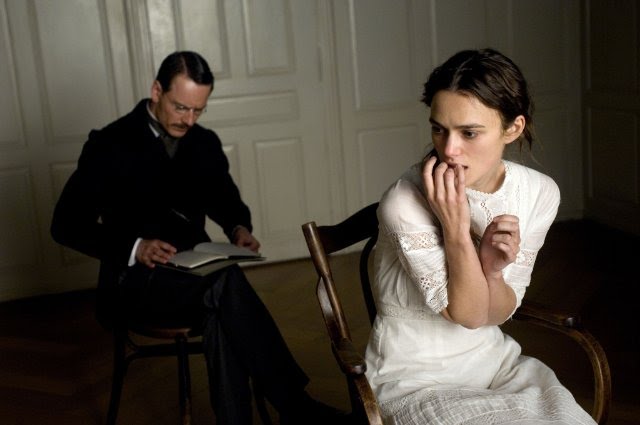
I came to David Cronenberg's "A Dangerous Method" with an eager anticipation that he would somehow conjur up the juiciness of "Dead Ringers," his wicked 1988 examination of twin libidinous gynocologists (both played by Jeremy Irons!), and somehow top himself.

But, no, "A Dangerous Mind" in which the ever-adventurous Cronenberg traces the birth of psychoanalysis (and, by extension, the curious pleasures of sexual sadomasochism) isn't the playful exercise that I expected. It is a bit more literal-minded - and, surprisingly, middle-brow - dealing as it does with the protégé/mentor relationship of Carl Jung (a watchful Michael Fassbender) and Sigmund Freud (an astonishing Vigo Mortensen), before they became professinal frenemies, and the interesting case study, the hugely neurotic Sabina Spielrein (an aptly feral and theatrical Keira Knightley), who came between them.

Sabina preferred punishing sex and found a willing partner in her psychoanalyst, Jung, but their taboo sex acts (always staged fully clothed) come across as curiously discreet and a tad dainty. (Rarely has sex seemed so obligatory.) Still, it was enough for Sabina to pursue a career in psychoanalysis herself, verifying the suspicion that, egad, most shrinks themselves are possibly damanged in the head.

Christopher Hampton adapted his play, "The Talking Cure," (a title that says all, in the case of this movie), working in elements from John Kerr's book, "A Most Dangerous Method." The talk - and there's a lot of it - is both super intelligent and kinda filthy, with the tony characters managing to work the words "penis" and "vagina" into most conversations.

Reading this stuff on paper might be slightly arousing but, on screen, it all seems, well, impotent. But I've a hunch that's exactly the point the provocateur Cronenberg wanted to make. Still, I liked his film.

A lot.

Sunday, January 01, 2012

prescient grief

Stephen Daldry's “Extremely Loud & Incredibly Close,” a shrewdly-made polemic linked to 9/11, functions largely as a road movie about an uncommonly bright boy (Thomas Horn) who goes in search of - what?

Relief?

Answers?

Or could it be simply a desperate need to understand "the impenetrable"?

In this case, "the impenetrable" is the loss of his beloved father (Tom Hanks) on that fateful day in one of the Twin Towers.

Oskar Schell (Horn) goes on a journey of grief for which, in some curious way, he was prepared by his doting dad - but which his mother (Sandra Bullock) is simply too distraught to understand. A mystery key that Oskar finds in an envelope left behind by his father, an envelope with one word scrawled rather cryptically on it, ignites his search for, again, what?

The answer - or explanation or solution or clue - is hidden somewhere in New York and among its denizens. And so, Oskar starts his journey.

Daldry, who previously helmed "Billy Elliott," "The Hour" and "The Reader," balances the destructive energy of 9/11 with the lovely redemptive poetry of Oskar's restless, utterly important search.

This delicate balance is handily achieved by the young actor Horn who is completely complicit with his director and who, almost preternaturally, resembles both Hanks and Bullock, particularly Bullock.

"Extremely Loud & Incredibly Close" goes beyond the trauma of 9/11 to get to the heart of palpable, achingly personal grief.