Monday, February 21, 2011

the horror! the oscars!

So I settled in last night and watched The Independent Film Channel which was showing Brian De Palma's "Carrie" (1976), a favorite that I haven't seen in years. OK, decades.

What a gorgeous horror film - so gorgeous that it made me think. Just about every year around this time, movie types bemoan the fact that comedies are predictably shut out of the Big Oscar Giveaway.

This is true. But the real bastard child of the Academy of Motion Picture Arts and Sciences is the horror film.

I mean, if Alfred Hitchcock's "Psycho" (one of the greatest horror films ever) failed to pass muster back in 1960, exactly what scare tactic would?

The movie year 2010 produced many wonderful films that have been shunted by the Academy's uninformed voters - Roman Polanski's "The Ghost Writer," Sofia Coppola's "Somewhere," Ben Affleck's "The Town" and Martin Scorsese's "Shutter Island", among them. But there was also one worthy horror entry - Matt Reeves' exquisite "Let Me In."

Comedy? Who cares?

Fact is, there were precious few screen comedies of any real worth in 2010 ("Sex and the City 2" anyone? "Love and Other Drugs"? "How Do You Know"? Heavens!), but there was at least one great horror movie.

Sunday, February 20, 2011

movies, newspapers and plagiarism

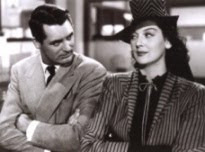
Cary encouraged Roz to plagiarize in "His Girl Friday"
In his ever-fascinating column, The Ethicist, in the New York Times magazine section, Randy Cohen answers a reader who rightfully questions if "The Social Network," a "Hollywood movie, the product of an industry often portrayed as a snake pit," should be tackling the issue of stealing, given its own propensity for plagiarism. Indeed.

During my years as a working journalist on the movie beat, I was always fascinated by the incredible disconnect between newspapers and the film industry when it came to the subject of plagiarism.

In newsrooms, the mere hint of "plagiarism," a word usually spoken in hushed whispers among newspeople, is enough to shrivle the testicles of any average male newspaper editor. An anonymous call from a reader (who may be certifiable or worse) heatedly accusing a staffer of plagiarism has often been the reason for countless closed-door meetings - the unfortunate staffer being guilty until proven innocent.

I know of one reptilian editor, playing Colombo, who actually stalked one of his writers, short of using surveillance, seemingly in the hopes of actually proving that the writer was guilty. Why? Why the avidity?

On the other hand, Hollywood not only shamelessly steals ideas and screenplay treatments, but actually seems to encourage its denizens to do so and will then go to great expense and lawyer up, going to court to prove that the similarities are all an unfortunate coincidence - and that the wronged party is just a greedy opportunist bent on destroying the studio.

Makes one wonder which is worse - newspapers or movie companies.

Wednesday, February 16, 2011

the hills are alive...

Ingrid Bergman made one of the most memorable comebacks in screen history. While making "Stromboli" in Italy in 1950, she fell in love with her married director, Roberto Rossellini, becoming pregnant by him. Times were different then. The American public, provoked by religious groups, ostracized an actress it once adored (Sister Benedict of "The Bells of St. Mary's"!) and, consequently, no Hollywood studio would touch her.

But six years later, she returned to American filmmaking with Anatole Litvak's "Anastasia," winning her second Academy Award. (The first was for "Gaslight.") It was obvious: All was forgiven. In 1958, she struck box-office gold with two hits - Stanley Donen's silky-smooth "Indiscreet" and Mark Robson's hugely popular "The Inn of the Sixth Happiness," the latter based the life of Gladys Aylward, a determined British woman who, most unlikely, became a missionary in China just prior to World War II.

The highlight of the film is its big finale when Bergman's Aylward escorts hundreds of Chinese children across mountain terrain while the kids sing the British traditional, "This Old Man." It's the greatest Rodgers and Hammerstein moment that had nothing to do with Dick and Oscar. Given the team's penchant for singing kids ("The King and I" and "The Sound of Music"), it's odd they never musicalized Aylward's story for the stage.

"The Inn of the Sixth Happiness," which runs an epic 158 minutes, is also noteworthy for the unusual participation of the fine German actor Curt Jürgens and the British Robert Donat in Chinese roles. While such casting would be eschewed today, considered politically incorrect and insensitive, the fact is both actors deliver solid, convincing performances, particularly Jürgens, who with little make-up, convincingly gives the appearance of the half-Chinese officer Colonel Lin Nan. (His father was Dutch.)

Mark Robson received the film's only Oscar nomination, which was more than well-deserved.

Turner Classic Movies, which has aired several difficult-to-see Fox films lately (Nunnally Johnson's "The Man in the Gray Flannel Suit," Henry King's "Tender Is the Night" and Henry Koster's "Good Morning, Miss Dove," for examaple - all with Jennifer Jones), will screen "The Inn of the Sixth Happiness" at 5:15 p.m. (est) on Sunday, 20 February.

Sunday, February 13, 2011

magnificent minnelli


It's no secret that Vincente Minnelli is my second-favorite filmmaker (running a close second to Hitchcock, natch), so it should be no surprise that I am beside myself that Dave Kehr elected to devote his New York Times DVD column to Warner Archives' decision to release four Minnelli titles - "The Cobweb” (1955), “Tea and Sympathy” (1956), “The Reluctant Debutante” (1958) and “Two Weeks in Another Town” (1962) - on discs.

For the first time.

All of this gives me a legitimate excuse to weigh in on Minnelli's rich mid-to-late-career as a filmmaker.

His last two films were the 1970 movie version of "On a Clear Day You Can See Forever," a film which begs to be restored (there are musical numbers by Jack Nicholson and Larry Blyden waiting to be reinstated) and the severely compromised "A Matter of Time," released in 1976 and also primed for a restoration (that's if the deleted footage even still exists).

But for all intents and purposes, Minnelli's final films were the dozen or so titles that he breathlessly made for MGM (plus one minor gem for Fox) during a quick ten-year period - from 1955 to 1965.

Few of them are considered classics, but all of them are good - very good - companionable films that share a master's sense of storytelling as Minnelli went from genre to genre to genre. Such variety!

I don't know about you but I find this list utterly fascinating:

1955 - "The Cobweb" and "Kismet"

1956 - "Lust for Life" and "Tea and Sympathy"


1957 - "Designing Woman"


1958 - "Gigi," "...Some Came Running" and "The Reluctant Debutante" (a banner year)


1960 - "Bells Are Ringing" and "Home from the Hill"

1962 - "Two Weeks in Another Town" and "The Four Horsemen of the Apocalypse"


1963 - "The Courtship of Eddie's Father"


1964 - "Goodbye, Charlie" (the lone 20th Century-Fox title)


1965 - "The Sandpiper" (after which he would not make a film for another five years)

The films themselves are an amazing collection, but think about the wide array of on-screen talent that participated, and the generations spanned - from Gregory Peck, Kirk Douglas, Glenn Ford, Elizabeth Taylor, Richard Widmark, Anthony Quinn, Lauren Bacall and Robert Mitchum, to Shirley MacLaine, Dean Martin, Richard Burton, Tony Curtis, Judy Holliday, Shirley Jones, Frank Sinatra and Debbie Reynolds, to ... Ronny Howard.