Friday, July 10, 2009

When Brüno Met Dieter

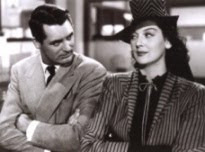
Teutonic Twins: Baron Cohen’s “Brüno” (above) owes its life to Myers' "Sprockets" (below)
Simply put, “Brüno” is "Borat" by way of "Sprockets."

Stylistically and in terms of its narrative drive, the new collaboration of star-auteur Sasha Baron Cohen and director Larry Charles is nearly indistinguishable from their "Borat: Cultural Learnings of America for Make Benefit Glorious Nation of Kazakhstan" (2006), only not as special, given that, well, this schtick has already been done. And done better.

But the character of Brüno himself is a near replica of Mike Myers' Dieter creation, the West German television talk show host that Myers whipped up with Dana Anderson for the Second City sketch troupe and which became a recurring character during Myers' run on "Saturday Night Live." Surely, you remember, the aloof miminalist "Sprockets" host demanding that his reluctant guests pet his monkey, Klaus. "Touch him! Love him! Liebe meine abschmenkee!"

Deiter was marginally funny then and Brüno is marginally funny now.

The bottom line is, Brüno is essentially a sexed-up Dieter - no more, no less. But, wait, back to "Brüno" and "Borat"...

Both are episodic, although "Brüno" is noticeably more scattered with comic sequences that come to no natural conclusion - i.e., most end without a punchline. They just ... stop. Abruptly. But what really sets these two apart is that Baron Cohen's shallow, celebrity-fixated opportunitist isn't nearly as likable as his crazed journalist from Kazakhstan. But then rampaging narcissists are rarely amusing.

As Dieter often said: "Your story has become tiresome. Please leave."

Note in Passing: Oddly enough, Myers once planned to bring his Dieter/"Sprockets" character to the big screen for Universal Pictures and Image Entertainment (the Ron Howard/Brian Glazer company). There was a contentious lawsuit when he decided to pass on the film. Universal is also the production company that produced and released "Brüno."

Wednesday, July 08, 2009

cinema obscura: Dore Schary's "Act One" (1963)


The playwright-director Moss Hart co-wrote both ''You Can't Take It With You'' and ''The Man Who Came to Dinner'' with George S. Kaufman and won his Tony as director for Lerner and Loewe's ''My Fair Lady.''

He also wrote the autobiography, “Act One,” which was filmed for Jack Warner and Warner Bros. by the legendary Dore Schary in 1963.

The little-seen, now-forgotten film, which stars George Hamilton as Hart, dwells on the early part of Hart's career, before he met and married Kitty Carlisle, and boasts an impressive supporting cast – Jason Robards as George S. Kaufman, Jack Klugman as Joe Hyman, Eli Wallach as Warren Stone, Sam Levine as Richard Maxwell, George Segal as Lester Sweyd, Bert Convy as Archie Leach (who would, of course, become Cary Grant) and the great stage actress Ruth Ford as Beatrice Kaufman.

It’s not a particularly good movie, but it does capture the atmospheric New York theater milieu with impressive accuracy – the glittering New York life that Moss Hart and Kitty Carlisle represented. Ambience.

You know - when life was all about the opening night on Broadway of “Auntie Mame,” a cocktail party on Beekman Place, a charity soirée at the Museum of Modern Art and a late-night supper at the Stork Club.

It's gone now.

Sunday, July 05, 2009

The New Woody. Wait!

Woody's latest isn't what it seems. That's the point.
Like most of Woody Allen's other late-career releases, his newest "Whatever Works" has been casually dismissed by movie opinion-makers, starting with the shrugs it generated at The Tribeca Film Festival.

And, frankly, for the first ten minutes or so, as star Larry David (standing in for Woody) talks directly to the camera and seemingly refuses to stop, the film had me squirming and cringing. "I already hate it," I whispered to my wife, ready to bolt.

But wait!

Its disasterous opening notwithstanding, "Whatever Works" quickly evolves into a highly companionable morality fable about a solitary, opinionated apathist/pessimist (the David/Allen character) who speaks authoritatively and negatively about life and people, threatening to poison everyone around him. The glory of the film is that it cleverly upends his dire theories, shrewdly pulling him into an extended family of free thinkers who have all taken his opinions and rehabilitated them - and him.

His life turns out to be a happy accident.

David plays Allen without resorting to the kind of mugging that other actors have adopted in Allen films and he's encircled by a deft ensemble - most notably, Evan Rachel Wood, Ed Begley, Jr. and Patricia Clarkson.

Saturday, July 04, 2009

façade: Anthony Mackie

The auspiciously talented Anthony Mackie, with Kerry Washington, in the red-hot role that should have made him a hot star - as the Red Bull-gulping stud/babymaker in Spike Lee's "She Hate Me."
Anthony Mackie is one of those actors who seems to operate on the periphery - someone who you catch out of the corner of your eye.

But once you catch him, you can't take your eyes off him.

In a word, he's riveting. He's impossible to shake.

Case in point: Ryan Fleck's "Half-Nelson" (2006) is Ryan Gosling's film - except when Mackie is on screen giving him a hard time. Crowding Ryan Gosling off the screen is no easy task, but Mackie did it. And not in any underhanded, scene-stealing way. He simply inhabited his character.

Completely.

More recently, he did the same thing in Tim Disney's affecting
"American Violet" (2008). Mackie has one scene (albeit a major one) and no screen credit (inexplicably). Yet, the movie is his.
Mackie in "Half-Nelson": Another easy theft
By my count, this charismatic, talented actor should have become a major star five years ago - in Spike Lee's compelling "She Hate Me" (2004) - but the film itself is (how shall I put this?) slightly audience-alienating. Before there was "Hung," there was "She Hate Me," in which Mackie plays a game guy who goes into the business of impregnating women - with the help of erectile-inducing drugs and steady shots of Red Bull. You either loved or hated the film; you either loved or hated Mackie. No matter how one feels about "She Hate Me," it's a singular film and Mackie's is a singular performance - both still waiting to be discovered.

And let's not forget the fire Mackie brought to Clint Eastwood's "Million Dollar Baby" (2004) and McG's "We Are Marshall" (2006).

Anthony Mackie is now back, ready to give us one more chance, in Kathryn Bigelow's powerful and provocative modern war drama, "The Hurt Locker" - again, a film that ostensibly belongs to its top-billed star, the talented Jeremy Renner, who plays a sergeant who is a gung-ho war enthusiast ready to play a form of Russian roulette with himself, but which Anthony Mackie quietly, handily, steals as another sergeant who is more grounded and who is tested by his buddy's dangerous sense of bravura.

Another great performance. One that should make Anthony Mackie a star.

Note in Passing: Mackie will be in New York this summer, as a member of the cast of the Public Theater’s Shakespeare in the Park production of “The Bacchae.” He will portray the role of Pentheus in the play; the previously announced cast for “The Bacchae” includes Jonathan Groff and André De Shields. “The Bacchae” is to be directed by JoAnne Akalaitis with original music by Philip Glass and translation by Nicholas Rudall. It begins previews at the Delacorte Theater in Central Park on August 11, opens August 24 and concludes its run on August 30.

Friday, July 03, 2009

Sarah Palin and The Star System


Sarah Palin, ten months ago.

What a year. Was it only ten months ago that John McCain tapped the then-unknown Sarah Palin as his running mate? Yes, Saturday, August 30th, 2008.

Flashforward to today - Friday, July 3rd, 2009 - and Palin's bizarre press conference to announce she doesn't want to be governor of Alaska anymore. She's received "a high calling," see, and has to go. Bye.

OK, you're asking, what does this have to do with movies?

Plenty.

Within the studio system, the likes of Joan Crawford and Bette Davis were held by the iron grip of Jack Warner - and flourished. Much like the actors forced to become freelancers immediately following the demise of the old studio system, Palin is a star who's somewhat adrift - rudderless - trying to control her own career and proving that she's not really up to the task.

I can't think of any major star or politician who doesn't have handlers, but Palin demonstrated throughout last fall's primary that she can't be - won't be - handled.

Sarah Palin, yesterday
Over the past 10 months, I've heard people respond to Palin's cringe-producing behavior and run-on sentences by speculating that either she is being poorly handled by her advisers or that she simply isn't taking their advice.

My hunch is that she has no advisors. She and Todd have been quite successful running their mom-and-pop operation up there in Alaska, and don't need any advice from fancy-talking, big-city strategists, thank you very much. (Take that, Steve Schmidt and Nicole Wallace.) But anyone who wants to make it in the Big Time, whether in movies or in politics, needs some kind of guidance, a perspective from a third party and the willingness to listen. Palin can learn from the movie's greatest survivors. If she wants to.

I don't think she wants to.

"I'll be seeing ya, Herbie!"

Karl Malden (1912-2009) between scenes during LeRoy's "Gypsy" with Natalie Wood (1938-1981)
The divine Karl Malden made 70 movies in 97 years.

Is it odd to call Malden "divine"? Well, he was. To me, at least. He elevated whatever movie in which he appeared, seemingly effortlessly.

Seventy movies - too many to recount here, but his wrenching performance as Archie Lee Meighan in Elia Kazan's "Baby Doll" (1956) serves as a textbook example of what it takes to be a great, seamless character actor. Then there's John Frankenheimer's "Birdman of Alcatraz," made the same year (1962) as Frankenheimer's "All Fall Down" and Mervyn LeRoy's "Gypsy," in which Rosalind Russell flirted with him in a way that suited Malden: "I'll be seeing ya, Herbie!"
Eli Wallach taunts Malden in Kazan's "Baby Doll"
Film historian David Thomson perhaps put it best with his clever take on Malden in LeRoy's musical: "A standout as the agent/hustler in 'Gypsy' ('62, Mervyn LeRoy), cannily absorbing all Rosalind's Russell."

Then there's Robert Mulligan's "Fear Strikes Out" (1957), in which Malden - presciently? - plays a male variation on "Gypsy's" Momma Rose as John Piersall, a stage father who hounds his son Jimmy (poor Anthony Perkins) to be a star, baseball-division.

But my own idiosyncratic favorite is perhaps his least heralded performance - opposite Claudette Colbert in Delmer Daves' "Parrish" (1961), in which he tried to "man up" Colbert's pampered son, Troy Donahue.

Malden died Wednesday. Goodbye to a great actor, a truly decent man...

Note in Passing: The ever-reliable Turner Movie Classics, always on the ball, will pay tribute to Malden with a mini-festival on Friday, 10 July, with screenings of "A Streetcar Named Desire" (Malden's Oscar winner), "On the Waterfront" and the aforementioned "Birdman of Alcatraz." Savor him.

Thursday, July 02, 2009

The Burt Reynolds Dinner Theatre

In the immediate previous post on Farrah Fawcett, I refer to The Burt Reynolds Dinner Theatre, a venue that deserves a bit of elaboration.

Located in Reynolds' hometown of Jupiter, Florida, the theatre was something of an unsung gem that opened in 1979, attracting high-profile performers in productions both new and tested duering most of the '80s.

Reynolds himself starred in several productions there - with Carol Burnett in Bernard Slade's "Same Time, Next Year" and with his then-love Sally Field in N. Richard Nash's "The Rainmaker."

Reynolds also acted with Stockard Channing in an Ernest Thompson one-act piece called "Twinkle, Twinkle" that was one-third of a trilogy known under the umbrella title "Answers." The other two titles by Thompson ("On Golden Pond") were "The Constituent," with Charles Durning and Ned Beatty, two frequent Reynolds co-stars on screen, and "A Good Time," featuring the then-married Kirstie Alley and Parker Stevenson.

Also: Neil Simon’s "The Odd Couple" featured Charles Nelson Reilly and Darryl Hickman; Julie Harris and Vincent Gardenia played in Arthur Miller's "Death of a Salesman," and James Farentino and Diana Scarwid paired for Herb Gardner's "A Thousand Clowns."

The theatre closed its doors in 1997 after Reynolds declared bankruptcy in 1996 - a nice idea that deserved a longer run.

Note in Passing: I don't know about you, but writing about Burt and Farrah brings Rona Barrett to mind for some reason.

façade: Farrah

A missive from Farrah ... Sleep well, sweet girl
Farrah Fawcett was laid to rest yesterday, ending an enchanting life and career. Much has been written about her during the past week, but four fascinating career points managed to elude all of the appreciations.

1. Farrah had her first major film role in 1970 as Mary Ann Pringle in Michael Sarne's controversial "Myra Breckinridge," based on the book by Gore Vidal. Most of her scenes were with Calvin Lockhart and Rex Reed.

2. Urged by her friend Burt Reynolds, Farrah tested herself on stage for the first time in July of 1980 at Reynolds' theater in Jupiter, Florida, playing Jill Tanner in Leonard Gershe's "Butterflies Are Free," opposite Dennis Christopher. Dom DeLuise, another Reynolds friend, directed. She would make her New York stage debut a few years later in 1983 in William Mastrosimone's "Extremities," following Susan Sarandon and Karen Allen in the lead role. She would subsequently appear in the Robert M. Young film in 1986.

A scheduled stage appearance as an insecure former beauty queen in Nancy Hasty's off-Broadway comedy hit, "Bobbi Boland," directed by David Esbjornson and scheduled to reopen on Broadway at the Cort Theatre on November 24, 2003, closed November 9 during its previews. The play was set in Florida in the late 1960s and demonstrated how far a former beauty queen will go to protect her realm. The character Bobbi was made for Farrah, but it was not to be. The show's sole producer, Joyce Johnson, said at the time that the that the play, a success off-Broadway, "simply does not work in a large Broadway house."

3. In 1990, Farrah appeared in a Gene Wilder comedy called "Funny About Love," playing one of Wilder's three leading ladies, the other two being Christine Lahti and Mary Stuart Masterson. But all of her scenes were cut by director Leonard Nimoy after alleged poor test screenings. Farrah played a woman who Wilder, cast as a professional cartoonist, meets while speaking at a convention of the Delta Gamma sorority - the kind of woman who always eluded him. Sounds like perfect casting. It was an important role and, without it, the film is lopsided - and the Delta Gamma scenes in particular have the scars of hasty editing. Hopefully, Paramount will now see fit to restore her missing scenes in some future DVD - that's if they still exist.

4. Like every Hollywood blonde, Farrah also had her personal immitator - Susan Anton, who had the same white smile and big hair. Anton, who was pleasing and had talent, seems to have had a fleeting career, her most memorable part being the title role in Joseph Sargent's "Goldengirl" (1979), which played in aborted form in theaters but was shown in its original extended version on television. Jessica Walter, unseen in the theatrical release, is prominent in the long version.

Finally, anyone planning an at-home Farrah Fawcett Film Festival, these are the essential titles:

Lamont Johnson's "Somebody Killed Her Husband" (1978)
Richard C. Sarafian's "Sunburn" (1979)
Robert Greenwald's "The Burning Bed" (1984)
Robert M. Young's "Extremities" (1986)
Charles Jarrott's "Poor Little Rich Girl: The Barbara Hutton Story" (1987)
Alan J. Pakula's "See You in the Morning" (1989)
Lawrence Schiller's "Margaret Bourke-White" (1989)
Robert Duvall's "The Apostle" (1997)
Robert Altman's "Dr. T and the Women" (2000).

Monday, June 29, 2009

cinema obscura: Sidney Lumet's "The Group" (1966)

Candice Bergen, Shirley Knight, Joanna Pettet, Jessica Walter, Kathleen Widdows, Mary-Robin Redd, Elizabeth Hartman and Joan Hackett - Lumet's clique
Arguably Sidney Lumet's biggest, least representative and least remembered film is his 1966, 150-minute version of the Mary McCarthy novel about eight Vassar women who are alternately friends and rivals - or "frenemies," as Carrie Bradshaw would put it more than 30 years later.

Yes, "The Group" - which Turner Movie Classics is airing today at 3:30 p.m. (est) as part of its Lumet tribute - is one of those films indirectly responsible for "Sex and the City's" toxic reign of terror.

It represents a subgenre which includes Jean Negulesco's deliciously camp "The Best of Everything" (1959) and Wendy Wasserstein's intelligent "Uncommon Women and Others" (1979) - a subgenre that apparently has been dumbed-down over the past 40 years.

Hence, "Sex and the City's" insipid preoccupation with expensive shoes, obedient men and very little else.

The brightest star of Lumet's ensemble of young women is Shirley Knight, already a double-Oscar nominee by '66, although Candice Bergen received more attention for her arch, cringe-worthy debut as the token lesbian of the bunch. (She can barely walk and talk at the same time, as one of her ungenerous co-stars put it at the time.) Joan Hackett and Elizabeth Hartman, both now gone, and Joanna Pettet and Jessica Walter, would go on to bigger and better roles, although Pettet would soon fade away; Kathleen Widdows would move on to daytime dramas, becoming a favorite of soap fans, and Mary-Robin Redd, the most affecting actress of the group, would return to her roots, the Broadway stage.

The male characters in this difficult-to-see film, all singularly unappealing, are represented by Richard Mulligan, Larry Hagman, James Broderick and Hal Holbrook, none of whom would past muster on "Sex and the City."

Not enough musculature among them, see?

Anyway, Pauline Kael dismissed the film as "carelessly busy, energetic but likable."

And it is.