Sunday, March 11, 2007

Bong Joon-ho's "The Host"/"Gwoemul"

The ability to discover a movie is rare in these days of endless and relentless buzz and hype. We're essentially told what whe should look forward to. So it's a distinct treat - and privilege - when a movie sneaks up on us. And that's the exact case with South Korean filmmaker Bong Joon-ho's "The Host"/"Gwoemul," a nifty, old-fashioned monster flick about, well, the unspeakable. To get to the point, "The Host" is a drop-dead hit.

Made with B-movie cunning and a keen appreciation of every natural-and-unnatural thriller that came before it - from Spielberg's "Jaws" to Honda's "Gojira" ("Godzilla") - Joon-ho's "The Host" doesn't play fair but rather confronts us with primal moments, both queasily comical and cruelly frightening, involving something hellish from the deep, a mutant tadpole or whatever. And the film, like its beast, explodes on screen with the vigor and brightness of a Jovian meteor. Made with extraordinary intelligence and style and surprising flashes of humor, "The Host" in the end is spellbinding, a sneaky celebration of what movies are supposed to be all about. By all means, treat yourself.

(Artwork: Bae Doo-na faces the worst in a scene from Magnolia Picture's "The Host"/"Gwoemul")

* * *

Anyone interested in perusing some 2060 of my film reviews, dating back to 1994, can do so by simply going to RottenTomatoes.Com

betty hutton, 1921-2007


Betty Hutton, 1921-2007


What a broad, what a delightful broad. And naturally so. It never seemed to be an affectation for the camera. Perhaps that's why she was so habitually underrated, especially by the MGM stable of players and craftsmen who allegedly were openly rude to her during the filming of George Sidney's "Annie Get Your Gun" (1950). They wanted their little Judy in the role. Well, frankly, I always preferred Betty Hutton's unpretentious perkiness to Garland's naked neediness.

And, let's face it. Anyone could have played Annie Oakley, but no one could have given as much as Hutton did to Trudy Kockenlocker in Preston Sturges' classic knockabout farce, "The Miracle of Morgan's Creek" (1944).

I just wish she had worked more, especially in musicals. I mean, she would have made a great Nellie Forbush in "South Pacific" (1958). And as much as I love Doris Day and Roz Russell in the roles, I still have fantasy flashes of Hutton as Babe Williams in "The Pajama Game" (1957) and as Madam Rose Hovick in "Gypsy" (1962).

In the end, she was right when she sang in "Annie"... "Anything you can do, I can do better!"

You sure could, Betty. Now, rest in peace, you little kewpie doll.

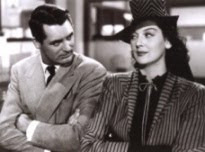
(Artwork: Betty in her prime)

* * *

Anyone interested in perusing some 2060 of my film reviews, dating back to 1994, can do so by simply going to RottenTomatoes.Com

Tuesday, March 06, 2007

McKay's “Talladega Nights: The Legend of Ricky Bobby”

“Talladega Nights: The Legend of Ricky Bobby” has become my cinematic cause celebre for the moment. Full Disclosure: I'm a sucker for any film that surprises me, something which rarely, if ever, happens these days.

So-called “deep think films" - works with messages, movies that came on the scene with the word IMPORTANT stamped on them - tend be the least interesting films to review or analyze. That’s because, in most serious films, the seriousness is all over their surface. There is nothing to really dig into because, surprisingly, most of these films have precious few layers. I’m thinking of titles such as “A Beautiful Mind” and “The Hours.” They are what they are, without anything hidden. There's nothing to search for, nothing underneath. It's all exposed.


Much more interesting are those mainstream-escapist movies that have subtle subterranean messages couched in their seemingly disposable plotlines. A lot of them are allegories that never bother to announce that they are allegories – and an excellent case in point is Adam McKay’s “Talladega Nights: The Legend of Ricky Bobby,” which utterly took me by surprise when I saw it last summer and has turned out to be – dare I say it? – one of the year’s very best films. Certainly, it is one of the year’s most deliciously subversive flicks.

As much as the film caught me unguarded, I was equally surprised (1) that its target audience accepted it, despite what I saw as an obvious agenda and (2) that so many critics didn't "get it," hastily dismissing it as just another silly summer escapist entertainment for guys (read: yahoos). Personally, I went just to kill some time and ended up being blown away.

“Talladega Nights” is a brilliant satire, a very shrewd and crafty – and highly original – political allegory. It would be easy to say it was an "accident" but, no, I actually think that some serious, barbed thought went into this film.

Will Ferrell essentially does a wicked buffoon impersonation of President George W. Bush, playing his NASCAR driver Ricky Bobby with equal amounts of arrogance, willful ignorance and delusions. He is totally sold on himself – the perfect narcissist – and totally oblivious and clueless about who he is and how he comes across.


Anyway, Ricky meets his match - and is immediately threatened by - Jean Girard (Sasha Baron Cohen, in a truly eccentric and restrained performance), an openly gay French driver out to defeat (and humble) Ricky Bobby.

Cohen has a few monologues in the film, directed at Ricky Bobby, pointing out exactly how limited Ricky is and how he hates anything he doesn't understand or anything that's different. To which Ricky Bobby routinely responds (with Ferrell brilliantly affecting President Bush’s vocal inflections), "America is the greatest country in the world!"

There's a great saloon showdown, in which Cohen defeats Ferrell and demands, "Say it! Say, 'I.. love... crepes.'" Ricky finally agrees to say it when his buddy Cal (John C. Reilly) explains that crepes are "skinny pancakes."

In one scene, Cohen is shown racing around the track while effortlessly reading Camus' "L'Etranger"! While the film was out, there was some nonsensical press about Bush's summer reading being "The Stranger." Think this notion came from a White House staffer/provocateur who saw the film? It's too much of a coincidence.

The movie works as a wonderful take on the clash of red-state-mentality with blue-state thinking. The film isn't really that subtle but if you dig deep enough, you'll find some amazingly political references. I personally thought it was kind of obvious, so it surprised that most people looked right through it and saw what they wanted to see – namely, a Will Ferrell frat-house comedy.

And the fact is, the movie does play on two distinctly different levels - and works on those levels. This is especially evident by the fact that the audience is never invited or encouraged to dislike or laugh at Cohen's gay French character. They actually sit there and accept the fact that the Frenchman is inarguably superior to Ricky Bobby – and, by extention, also an inspiration to him. Ricky spends the rest of the film trying to rehabilitate himself.


The high point has Jean Girard challenging Ricky Bobby to kiss him on the lips – a shot that McKay lets linger and that the audience fully accepts. No wincing here. And after the kiss, Cohen says to Ferrell, "You taste like an American." I've seen the film three times and was amazed by how much anti-American subversiveness that it dishes out.

There’s also an extended dinner-table sequence devotedly mostly to a prayer of grace to "the Baby Jesus." The sequence's gleefully unrestrained irreverence is better – and more outspoken – than anything in the many indie films that come on the scene announcing themselves as "biting social comedies" but that actually dare or risk little.

And this exchange is a keeper:

Ricky Bobby: "OK, exactly what have the French given the world?"

Jean Girard: "Democracy, existentialism and the menage-a-trois."

Cal (missing one perfect beat): "They're three pretty good things."

When Jean Girard asks Ricky and Cal what Americans have contributed to the world, all they can come up with is Pizza (from Italy actually), Chinese food (from China) and ... taquitos. Priceless.

One last thing: Moviegoers go into films in specific states of mind, depending on the film in question. We're more on the ball at serious films. When one goes to see a serious film with a message – again, such as “The Hours” – one is geared up to learn something. You sit erect and take in the lesson.

But we're more vulnerable, almost childlike, when we go to see a film that's strictly escapist/entertainment. Less on guard, we let down our defenses. We're not there to learn anything – just be entertainment - and are more likely to be seduced in the dark. A film like “Talladega Nights” invites audiences to kick back and relax and let the film flow over them. We're unaware that we're being fed anything but entertainment, unware of the possible messages coming at us subliminally. When this happens, "entertainment" films have the potential to be much more potent (and sometimes more dangerous) than a film hyped as having a Big Message.

"Talladega Nights: The Legend of Ricky Bobby" becomes available on DVD today, December 12th.

(Artwork: from top: Still shots of Will Ferrell, John C. Reilly and Sasha Baron Cohen in Columbia Pictures' "Talladega Nights: The Legend of Ricky Bobby")

* * *

Anyone interested in perusing some 2060 of my film reviews, dating back to 1994, can do so by simply going to RottenTomatoes.Com

Monday, January 29, 2007

Caouette's "Tarnation"


Jonathan Caouette's incredibly modest but undeniably impressive "Tarnation" was the last film that I saw as a professional film critic. After spending most of my life at the movies, and all of my adult life reviewing them, I had decided to live my own script - retire young and kick back. And Caouette's film lent itself perfectly to my valedictory review because it's the kind of movie that I think I championed as a critic - and because his film struck me in such an intensely personal way.

We all react to movies in different ways because, well, no two of us are exactly like. And when a film seems to be talking to us, directly and personally, its meaning can become revelatory - particularly when it arrives at a crucial point in our lives.

For me, "Tarnation" was the right film at the right time.

The movie is essentially a video diary of Caouette's chaotic life, a filmic mosaic consisting of bits and pieces of memorabilia - Super-8 home movies, both Betamax and VHS video footage, family snapshots, old answering-machine messages, excerpts from movies and TV series from the '70s and even "re-enactments" - that Caouette was moved to edit together using the iMovie software on his laptop. He reportedly had 160 hours' worth of personal material and spent $218.32 to put it together.

Caouette, 32, isn't a trained filmmaker, but he is a natural one. He has a sense of rhythm and he knows what's important and what's not and, as a result, his film flows naturally.

"Tarnation" opens with a re-enactment - with Caouette in Queens, receiving a phone call notifying him that his severely troubled mother back in his native Texas has overdosed on lithium and has more or less deteriorated into a zombie. This latest personal trauma prompts Caouette to go to Texas and bring what's left of his mother back to New York, while filling us in about their lives.

Renee LeBlanc, his mother, was born and raised in a Houston suburb and was a child model until a freak accident ended her career - and seemingly her life - at age 11. She fell off the family's garage roof and was temporarily paralyzed for six months. Her parents, Rosemary and Adolph Davis, were simple people who went along with the confused doctors when they suggested a round of electro-shock treatments. Caouette reasons that his mother was subjected to 200 such treatments, making LeBlanc unstable and incorrigible - and erasing her personality.

Caouette's father left before he was born - he didn't know LeBlanc was pregnant - and she eventually took her little boy and ran off to Chicago. While on the road, she was raped in front of her 4-year-old son by a man who picked them up. Kicked off a bus taking them back to Houston for making a disturbance, LeBlanc was arrested and Jonathan was placed in foster homes, where he was physically and sexually abused. He ended up living with his grandparents, whose hold on reality was tenuous at best.

By age 10, Caouette was aware that he was gay, but didn't know that he had his own mental illness - a "depersonalization disorder," which means he sort of sees himself from the outside. In keeping with this idea, "Tarnation" has no narration to hold its pieces together but instead uses detailed title cards in which Caouette continually refers to himself in the third person.

Caouette's personal documents here are utterly fascinating. We see self-filmed video footage of him, at age 11, doing improvised monologues as abused women, one white and one African American. It's incredible - and a little scary. Later, in what feels like a companion scene, we see LeBlanc in New York, her madness full-blown now, also "acting out" for Caouette's camera.

We also see Caouette involved in his high school's bizarre drama club, helping to construct a musical based on David Lynch's film "Blue Velvet," using songs by Marianne Faithful. Then we hear him recount how he used to get into gay bars by disguising himself as "a petite goth girl" and how his mind was eventually blown on a joint laced with PCP and embalming fluid.

And in a collage that is nothing short of jaw-dropping, Caouette charts his teenage years using footage of Ruth Gordon and John Casssavetes in "Rosemary's Baby," a scene of Dolly Parton singing "A Lil' Ole Bitty Pissant Country Place" from "The Best Little Whorehouse in Texas," the sound of Glenn Campbell singing "Wichita Lineman," moments from amateur horror films he made with his friends (with titles such as "The Spit and Blood Boys") and, most evocative, a shot of himself lip-syncing to Suzette Charles' rendition of "Frank Mills" from the "Hair" soundtrack. What comes through all of this is the filmmaker's psychic pain and confusion.


But it all comes back to the tragically damaged LeBlanc, one of the most affecting figures you're likely to see in any movie. If this were a fiction film, Debra Winger would be playing this role.


Once vital and beautiful, her deterioration is now beyond repair.

Caouette needs answers that his mother is not equipped to give. He wants to get to know her and, at the same time, as he puts it, "I'm so afraid I'm going to turn into my mother."

"Tarnation" is about life slipping away beyond our control, not just our own but the lives of people precious to our lives, people who, once gone, will leave a void that can never be filled. In Caouette's case, he began losing his mother the day he was born. In a scene that will forever haunt me, we see LeBlanc taking a nap - temporarily at peace, free from her demons.

"She's inside me," Caouette comments softly.

I originally saw this film shortly after my mother died, and while I certainly didn't have the miserable childhood that Caouette experienced, I related strongly to his sense of helplessness, to his desire to stop time and perhaps go back in time. The line, "she's inside me," really reverberates and says it all.

My mom was the first person to take me by the hand and introduce me to the world of movies, the first person to ask what I thought of this film or that one, the first person to care about my opinion. I think she's the reason I became a critic. In later years, as our roles became reversed, I reciprocated by taking her by the hand to the movies and asking her what she thought.

There are kinds of movies. The special ones - such as "Tarnation" - will stay with me forever - like memories of a long-gone loved one.

(Artwork: Family snapshots of filmmaker Caouette and his mother Renee, then and now, from Wellspring's "Tarnation")

* * *

Anyone interested in perusing some 2060 of my film reviews, dating back to 1994, can do so by simply going to RottenTomatoes.Com
Friday, January 05, 2007

stephanie von buchau, 1939-2006


When my wife and I relocated to the West Coast from the Philaldelphia area, I was professionally - and immediately - befriended by Stephanie von Buchau, a great critic who turned out to be an even better friend. We had a lot in common in that we were critics who marched to decidedly different drummers in terms of taste, mostly commiserating about misunderstood films, either pro or con.

I remember vividly last corresponding with her - via email - about the unappreciated joys of Tony Scott’s brutally raw and gleefully rude “Domino.” I think you get the picture.

Stephanie was iconoclastic , outspoken, fearless, sometimes brutally harsh, often very funny and uncommonly honest. She had provocative ideas and she did what every good critic should always do.

She made you think.

For those unfamiliar with Stephanie’s work and opinions, she reviewed classical music and opera, as well as film and food, from the Bay Area for about 30 years, her critiques appearing in such local publications as Marin County’s Pacific Sun, San Francisco magazine, the Oakland Tribune, the San Francisco Examiner and the Bay Area Reporter, as well as national magazines such as Opera News. In recent years, Stephanie had rather wittingly adopted the pseudonym Tiger Hashimoto for some of her reviews for the Examiner.

She inadvertently created a furor in 1975 with her negative review of the San Francisco Opera production of Tchaikovsky's “Queen of Spades,” as conducted by Russian exile Mstislav Rostropovich. The Opera’s late General Manager, Kurt Herbert Adler, responded by banning Stephanie, denying her press tickets for the remainder of the season. Her colleagues, however, objected, and Stephanie’s name was reinstated.

Perhaps, the veteran music and dance critic Allan Ulrich described Stephanie best: "She was blunt, insightful, cranky, outrageous and the voice of sweet reason, sometimes all in the same paragraph, She knew her business. And she was opinionated - she believed things should be a certain way in the arts. Whether you agreed with her or not - and I frequently disagreed violently with her - she stated her case cogently and wittily. She was damned entertaining to read.''

When my wife and I moved back to the East Coast after 13 years, I continued my email conversations with Stephanie but towards the end, our missives started to dwindle. And then they stopped - abruptly. Stephanie von Buchau passed away last December 19 at age 67, most likely from complications from the diabetes she battled most of her life.

That’s when she wasn’t waging a battle on behalf of art.

"The only truly objective critic is a dead critic," Stephanie once observed, but I’ve a hunch that even in death, she’s still eschewing the notion of objectivity and, well, raising hell.

Just as she did in life.

(Artwork: The great critic Stephanie von Buchau hiding behind a facade, photographed by Anne Hamersky in San Francisco in August, 1990)